
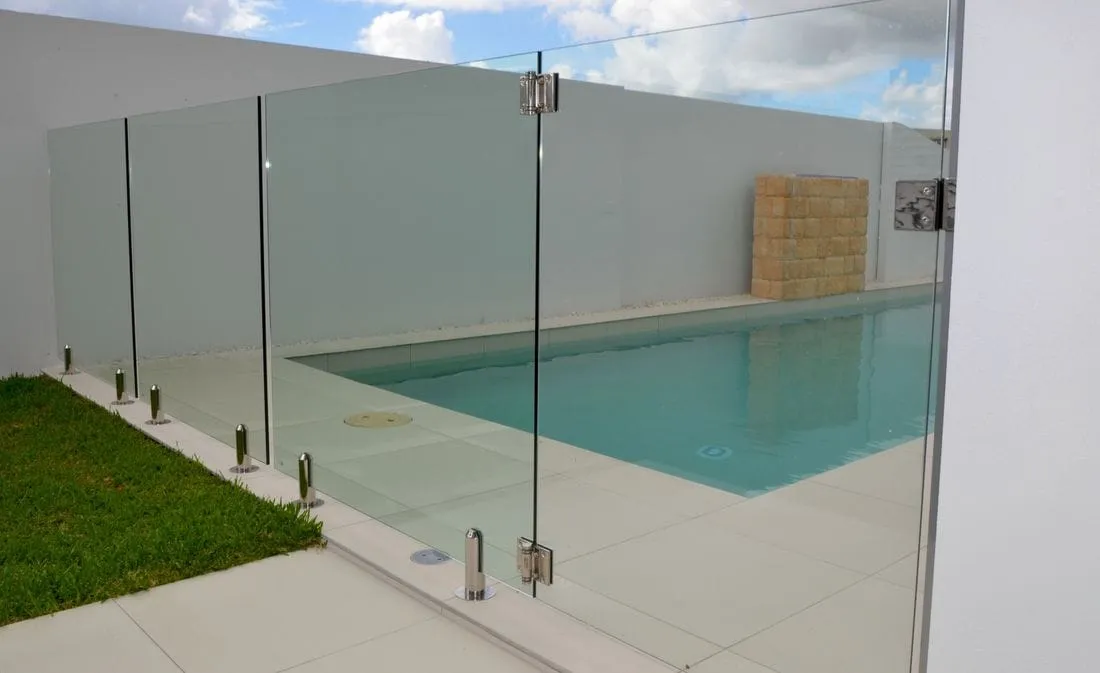
On the Gold Coast, there are two main types of pool fencing: frameless and semi-frameless. Frameless fencing is a 12 mm thick toughened glass panel, which is supported directly on the ground without vertical columns and provides the highest visual transparency. Semi-frameless fencing features thinner 10 mm glass panels with vertical posts that are set apart, providing more flexibility at a lower cost. When installed properly by a licensed professional, both systems meet the Queensland pool safety legislation.
Frameless glass pool fencing consists of a barrier made of toughened glass, usually 12 mm thick, that is anchored directly to the ground with stainless steel spigots or core-drilled anchor points. There are no vertical posts between the panels. The fence is structurally sound only because of the thickness of the glass and quality of the base fixings.
The end product is a clean, post-less glass barrier that has no obstructions between the homeowner and the pool. This is considered to be the top system for residential pools in the Gold Coast area where outdoor living, modern design and property aesthetics are all factors that are pushing for a high specification finish.
Semi-frameless glass pool fencing uses thin vertical posts of powder-coated aluminium or stainless steel placed between the glass in the fencing. The posts are used for structural support to enable the use of thinner 10 mm toughened glass. Optional rails may be installed at the top, bottom or both, as per design and site requirements.
The middle range glass pool fencing is the semi-frameless fencing. It offers much greater visibility and a more attractive appearance than timber and aluminium slat fencing, but is more affordable than a full frameless fence. It also is more tolerant of site variability.
Feature | Frameless | Semi-Frameless |
Glass thickness | 12 mm toughened | 10 mm toughened |
Vertical posts | None | Present at intervals |
Visual transparency | Maximum | High |
Typical cost (Gold Coast) | AUD $275–$600+/m | AUD $200–$275/m |
Compliance standard | AS 1926.1-2012 | AS 1926.1-2012 |
Terrain adaptability | Lower | Higher |
Hardware exposure | Ground-level spigots | Above-ground posts |
Climbability | Nil | Must verify rail design |
Best suited for | Premium, contemporary homes | Cost-conscious, complex sites |
Yes. When properly installed, both frameless and semi-frameless glass pool fencing systems meet all the requirements of Queensland pool safety legislation. The Australian Standard AS 1926.1-2012 is the governing standard, which is administered under the Building Act 1975 and Queensland Development Code.
Both systems have key compliance requirements that apply, including:
The licensed installer must provide a Form 15 compliance certificate at the end of the installation. Before they start work, homeowners should ensure that their installer has a current QBCC licence.
Also See: Total Vision Pool Fencing
Both frameless and semi-frameless systems have very high structural degradation resistance glass panels. The weak point in both systems is the metal hardware spigots, posts, hinges and gate latches.
The coastal air and high humidity at the Gold Coast, combined with the UV rays of subtropical weather, and the corrosive chemistry of chlorinated or saltwater pool systems, all take their toll on Gold Coast properties. These conditions can lead to a variety of corrosion processes in pool fence hardware, such as: chloride induced pitting, dissimilar metal galvanic corrosion, and chloramine off-gassing.
Grade 316 stainless steel is a marine grade stainless steel that has a higher content of molybdenum, making it much more resistant to chloride-induced corrosion than grade 304 stainless steel. Installations in the Gold Coast, especially within 2km of the coast, should be at least Gold Coast Grade 316. For maximum durability, 2205 duplex stainless steel may be used for properties in higher exposure coastal areas.
A professional grade protective nano-coating should also be applied to glass panels at installation on both frameless and semi-frameless systems. These coatings adhere to the glass surface on a molecular level and repel water, salt and pool chemicals, and help prevent mineral scale and etching.
Frameless and semi-frameless glass pool fencing both need routine upkeep in the Gold Coast climate. Both systems use the core protocol:
If you select frameless pool fencing:
If you prefer, opt for semi-frameless pool fencing when:
Whether you opt for the one you’ve always wanted or the one you need, the key considerations are hardware grade, installer licensing, and long-term maintenance agreement.
Frameless pool fencing is 12 mm toughened glass panels that are fixed at the bottom of the pool by spigots that are driven into the ground and do not have vertical posts. Semi-frameless pool fencing is made up of 10 mm glass panels and vertical posts that are placed between the glass panels. The main differences are in terms of visual clarity, pricing, and adaptability of structure.
Semi framed pool fencing is also more affordable and cost between AUD $200 and $275 per linear metre, professionally installed on the Gold Coast. The price of frameless pool fencing is usually in the range of AUD $275 to AUD $600 or higher per linear metre, depending on the type of hardware used and the complexity of the site.
Frameless and semi-frameless glass pool fencing systems are compliant with Queensland pool safety requirements as specified in AS 1926.1-2012 when installed by a QBCC licensed glass fence installer and a Form 15 compliance certificate is issued at the completion of the installation.
Frameless pool fencing in Queensland must meet the Australian Standard AS 2208 and be at least 12 mm thick toughened safety glass. Semi-frameless systems with vertical posts must be protected with at least 10 mm toughened glass.
Grade 316 marine grade stainless steel is the minimum recommended hardware specification for all Gold Coast pool fence installations, given the coastal salt air environment, and exposure to pool chemicals. 2205 duplex stainless steel can be used for properties within 2 km of the coast or at high exposure areas.
When properly specified and installed with Grade 316 stainless steel hardware and properly maintained under a regular service maintenance schedule, both frameless and semi-frameless glass pool fencing systems can last for 20 to 30 years in the Gold Coast environment. Long-term longevity depends mostly on the quality of the hardware, regular maintenance and balance of the water chemistry in the pool.